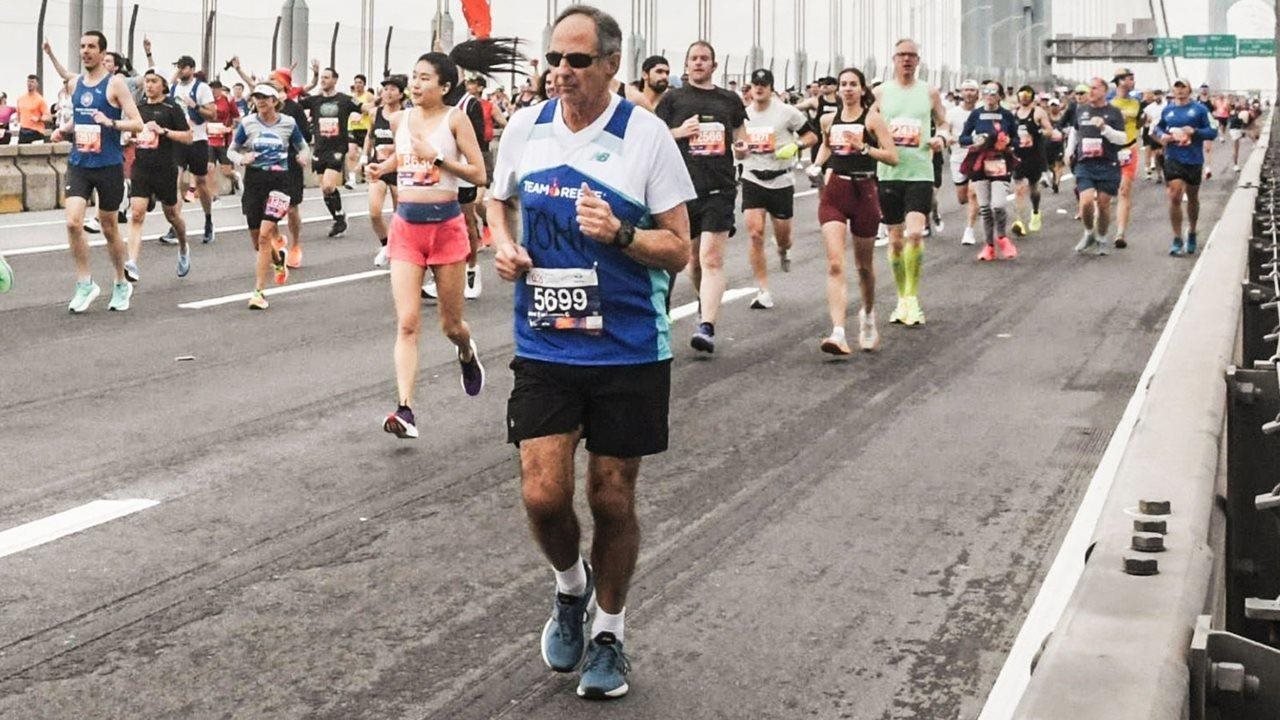
One November morning in 2005, media executive John McConnell woke up late for a bike ride and run with his friends. Sprinting out the door, running shoes in hand, he quickly got on his bike, knotted the shoelaces together and hung them over his bike's crossbar. This seemingly innocuous choice would soon change the trajectory of his life.
During McConnell's bike ride, one shoe slipped and got stuck in the bike's front fork. The bike stopped, but McConnell didn't. He pitched forward and landed on the right side of his head.
"In that moment, I couldn't move," McConnell said. "I was completely frozen. The only thing I could feel was my right pinky."
In the emergency room, doctors found fractures to his C1 and C2 vertebrae and informed McConnell that he might never walk again, if he survived at all.
Luckily for McConnell, his situation wasn't as dire as his original prognosis. Upon further examination, he was diagnosed with spinal shock, a temporary loss of reflexes, muscle movement and feeling below the spinal injury. By the time his wife arrived, McConnell was able to move his arms. Just one week after the accident, McConnell walked 2 miles into town.
Although McConnell's paralysis was brief, the accident left him with a profound sense of gratitude.
Five months later, still in rehab and wearing a brace, McConnell spotted an article in the Sunday paper about the Christopher & Dana Reeve Foundation — an organization dedicated to curing spinal cord injury by advancing innovative research and improving the quality of life for individuals and families impacted by paralysis. As he read on, McConnell discovered that the Foundation needed runners for the New York City Marathon, which would take place exactly one year to the day after his accident.
"This was a sign," he said. "In that moment, I decided I was going to do it." He immediately called four friends who had been helping him recover from the accident and they all jumped in to train and run the marathon together.
That fall, in 2006, McConnell joined Team Reeve, completed the marathon and raised $50,000 for the Foundation. More importantly, he got to know the Foundation's work and the people behind it. The next year, he raised $100,000.
"The Reeve Foundation symbolizes faith and belief that change will continue to happen — that we can make it easier for people living with spinal cord injury and those who care for someone with paralysis to navigate their journeys, provide hope and direction, and help them live full lives," he said. "There is no end to this endeavor; it is a continuum, moving forward every day: What's next? What's new?"
Since 2006, McConnell has run nine marathons for Team Reeve and recruited dozens of friends to join him along the way, helping him to raise several million dollars for spinal cord injury research. But his work didn't stop with Team Reeve. McConnell joined the Foundation's board and has served for 20 years, helping guide and support its mission.
He has championed Reeve's drive to improve quality of life for people with injuries through the extraordinary work of the National Paralysis Resource Center (NPRC); funded by the Administration for Community Living and administered by the Reeve Foundation, the NPRC is the only national program that directly serves the 5.4 million Americans living with paralysis. Mconnell personally introduces newly injured individuals and families to its vital services.
"People outside our community do not understand how devastating a spinal cord injury can be," he said. "Everything changes in an instant. Everything for you, for your family, potentially for your professional future, your personal future, your financial well-being. Everything changes in a minute. We get to make a difference."
More than a race
As McConnell's story shows, a marathon is more than just a race, and Team Reeve is more than a running group. As the Foundation's peer-to-peer fundraising program, Team Reeve supports spinal cord injury research and better quality of life for people and families affected by paralysis. Fundraisers enter major races — including the Boston, Chicago and New York City marathons — while supporters can create local events and personal challenges. Together, Team Reeve participants have raised more than $13 million to advance research and help people navigate daily life with paralysis.
Beyond fundraising and raising awareness, these endurance events connect the spinal cord injury community. Families, friends and advocates come together to support one another and Team Reeve's vision: a world in which spinal cord injury does not result in paralysis and paralysis does not result in diminished quality of life.
Every runner has a why
Every person who runs with Team Reeve has their own reason for running. For Patrick Yalon, running became a way back from a surfing accident that caused a C3-C5 injury and left him unsure whether he would walk again. He still lives with nerve pain, but movement returned a measure of control.
"One step became another. Walking became running," said Yalon, who is currently training for New York. "To go from not knowing if I would walk again to running through New York City for the spinal cord injury community is something I will never take for granted."
Like Yalon, Ulrika Holmquist is also running to rebuild her life. A 2025 racing accident ended her career as a professional jockey and resulted in three spinal surgeries. Through running, she was able to restore her strength and more.
"Running became a turning point in my recovery," said Holmquist, who is training for the 2026 TCS New York City Marathon. "It gave me back confidence, purpose and belief in myself."
For some Team Reeve members, their "why" is a loved one. Erica Bazerkanian, for example, runs for her father. Through team #IAMSTONE, she has raised $215,000, while her company, Bold&Zeal, donates 10% of purchases to the Foundation.
"Charity running is not just something I do," she said. "It is part of who I am. I run to raise awareness, fund progress and honor my father's legacy. The New York City Marathon is my way of turning pain into action, one step at a time."
For Marea Narsavage, her "why" begins with gratitude. As a Navy veteran, endurance athlete, altruistic living kidney donor and Angel Runner, she treats physical ability as a chance to serve others.
"Running the New York City Marathon is about far more than crossing a finish line," she says. "For me, it is an opportunity to raise awareness, give back and use my physical ability to help those who have not been given the same opportunities. It is about living with gratitude and turning that gratitude into action."
Team Reeve's starting line also welcomes athletes who move differently. Stacey Mahdavian — who became paralyzed in a car accident 36 years ago — tackles race courses on a handcycle, while her daughter Stacia runs beside her as a guide. This mother-daughter partnership captures Team Reeve at its best, a combination of athletes living with paralysis, families and supporters moving toward one goal.
The next starting line
Every participant's "why" differs. But whether they're running to reclaim their identity, in memory of a loved one or in gratitude, each Team Reeve member's story widens the circle of support, funds and community.
Team Reeve will gather next at the 2026 Bank of America Chicago Marathon on Oct. 11 and the 2026 TCS New York City Marathon on Nov. 1, followed by Boston and London in April 2027.
Every mile starts with a reason, and every reason can become action. To learn more, support an athlete or start a fundraiser, visit TeamReeve.org.


