
Most of the time, you don't think about your heartbeat. It works quietly in the background of your day. But sometimes your heart's rhythm sends important cues from your body.
Heart rhythms can tell a story with the power to change a life.
You may notice heart palpitations, sensations like fluttering, pounding or skipped beats. Heart palpitations are common1, accounting for 16% of visits to primary care physicians, and are the second leading cause of visits to cardiologists.2 While experiencing these can feel scary, these fluttery sensations are common and often harmless, caused by temporary stressors. But in some cases, they can signal an arrhythmia.
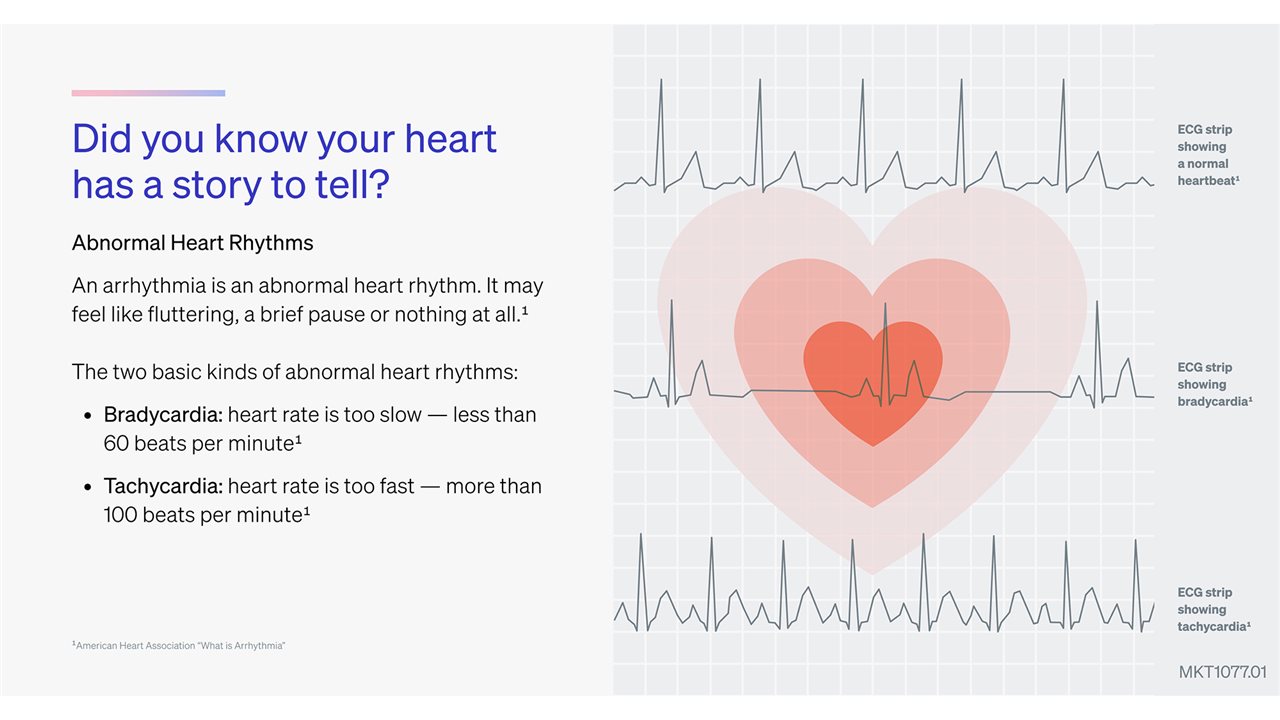
An arrhythmia is an abnormal heart rhythm where your heart may beat too quickly, too slowly or irregularly, and it's a condition that requires medical attention.
But not all arrhythmias cause noticeable symptoms. In fact, some people are asymptomatic, meaning they feel nothing at all. Up to one-third of people with atrial fibrillation, or Afib, a common arrhythmia with an irregular and often very rapid heart rhythm, are asymptomatic at the time of diagnosis.3 It is estimated that up to 27 million Americans may be at risk for undiagnosed arrhythmias.4
Even without symptoms, untreated arrhythmias can damage the heart, brain or other organs5 and may increase the risk of stroke or death.6
Understanding your risk and the importance of early detection
How can you do better by your heart? The good news is that arrhythmias can be highly treatable, especially when they are identified early. Taking steps to understand your heart health can make a meaningful difference. And that includes early detection and treatment of arrhythmias to reduce the burden of cardiac disease.7
One way to support early detection is by understanding your personal risk factors and discussing them with your healthcare provider. You can also reduce certain risk factors that are associated with arrhythmias. Risk factors for arrhythmia include heart disease, high blood pressure, obesity, diabetes, sleep apnea, alcohol use and family history.8
While arrhythmias and related conditions are more common in adults over age 609, they're not limited to older populations. AFib, as an example, has historically been associated with aging. However, emerging research shows that there has been an increase in younger patients getting diagnosed with AFib.10
A medical evaluation may include heart rhythm monitoring to better understand what's happening with your heart. In some cases, physicians may recommend heart rhythm monitoring based on a patient's risk factors, even if noticeable symptoms are not present.
A path forward
The path to getting a diagnosis and understanding your specific arrhythmia hasn't always been easy.
Not long ago, determining whether you had an arrhythmia required a visit to a hospital or clinic for an electrocardiogram, or ECG. Because arrhythmia episodes often come and go and must be recorded while they are occurring, a brief in-clinic ECG could miss an episode. In some cases, repeat testing was needed, or the condition went undetected.
Holter monitors, wired devices introduced decades ago and typically worn for 24 to 48 hours, are sometimes still used to evaluate heart rhythm. However, because many arrhythmias occur intermittently, these shorter monitoring periods may not always capture and record an episode because some people could go days or weeks without an episode. In fact, three out of four patients who use a Holter monitor do not get a diagnosis on the first test.11
Some consumer wearable devices and smartwatches can detect irregular pulse patterns and may alert you to seek medical attention. While these tools can be helpful in prompting follow-up, they do not lead to a medical diagnosis. If you receive an alert from a smartwatch or wearable device, follow up with your healthcare provider. A medical-grade ECG is typically needed for your doctor to confirm and formally diagnose or rule out an arrhythmia.
Modern medical-grade ECG monitors can now be worn at home and continuously record your heart's electrical signal for longer than 24 to 48 hours if your doctor prescribes it.
One example is the Zio® ECG monitoring service, which includes a small wearable patch device designed to record heart rhythm data during normal daily activities without wires or battery changes during the wear period. Zio ECG monitoring devices can record heart rhythm continuously for up to 14 days, helping physicians diagnose arrhythmias more accurately.
Advances in heart rhythm monitoring are making it easier for physicians to detect arrhythmias that might otherwise go unnoticed.
Paying attention to your heart's rhythm, especially if you have symptoms or risk factors, can help ensure you receive appropriate care. If you have concerns, talk with your healthcare provider about whether further evaluation is right for you.
Your heart's story is worth knowing. With the right tools and care, it can be a long and healthy one.
A patient perspective
Charissa H., 40, fainted during a routine walk and was taken to the emergency room. At the time, ECG monitoring in the ER did not reveal any concerning heart rhythm findings.
Before she was discharged, her care team applied a Zio®AT12 monitor prescribed by her physician.
About a week later, Charissa fainted again. This time, the heart monitor she was wearing captured what was happening.
With data from the Zio monitoring service, her doctors were able to diagnose an arrhythmia and move quickly to provide the treatment she needed — an implantable cardioverter defibrillator (ICD).13
1 Raviele A, Giada F, Bergfeldt L, et al. Management of patients with palpitations: a position paper from the European Heart Rhythm Association. Europace. 2011;13(7):920-934
2 Wexler, et al. Palpitations: Evaluation in the Primary Care Setting. Am Fam Physician, 2017.
3 Sgreccia et al. Comparing outcomes in asymptomatic and symptomatic atrial fibrillation: A systematic review and meta-analysis of 81,462 patients. Journal of Clinical Medicine. 2021;10(17):3979. doi:10.3390/jcm10173979
4 iRhythm internal estimate based on analysis of public and proprietary sources, including U.S. Census Bureau data, CDC healthcare utilization data, Medicare Public Use Files, IQVIA, Komodo Health, Definitive Healthcare, and peer-reviewed literature on arrhythmia prevalence, symptom presentation, and diagnostic pathways. Full source list available upon request.
5 What is an arrhythmia? National Heart Lung and Blood Institute, 2022. https://www.nhlbi.nih.gov/health/arrhythmias Accessed November 18, 2022
6 Ataklte et al. Meta-analysis of ventricular premature complexes and their relation to cardiac mortality in general populations. The American Journal of Cardiology, 2013.
Lin et al. Long-Term Outcome of Non-Sustained Ventricular Tachycardia in Structurally Normal Hearts. PLOS ONE, 2016.
Wolf et al. Atrial fibrillation as an independent risk factor for stroke: the Framingham Study. Stroke, 1991.
7 Rillig et al. Early Rhythm Control in Patients With Atrial Fibrillation and High Comorbidity Burden. Circulation. 2022;146(11):836-847. doi:https://doi.org/10.1161/circulationaha.122.060274
8 Arrhythmias: causes and triggers. National Heart Lung and Blood Institute (NHLBI), 2022
9 Mirza et al. Mechanisms of Arrhythmias and Conduction Disorders in Older Adults. Clinics in Geriatric Medicine. 2012;28(4):555-573. doi:https://doi.org/10.1016/j.cger.2012.08.005
10 Noubiap, J, Tang, J, Teraoka, J. et al. Minimum National Prevalence of Diagnosed Atrial Fibrillation Inferred From California Acute Care Facilities. JACC. 2024 Oct, 84 (16) 1501–1508. https://doi.org/10.1016/j.jacc.2024.07.014
11 Tsang, et al., Benefits of monitoring patients with mobile cardiac telemetry (MCT) compared with the Event or Holter monitors. Medical Devices: Evidence and Research, 2013.
12 Do not use Zio AT for patients with symptomatic episodes where variations in cardiac performance could result in immediate danger to the patient or when real-time or in-patient monitoring should be prescribed. The Zio AT device is not intended for use in critical care patients because the reporting timeliness is not consistent with life-threatening arrhythmias such as ventricular fibrillation. Refer to Zio AT Clinical Reference Manual for additional information.
13 Individual results may vary. Contact your doctor to determine whether ECG monitoring is right for you.


