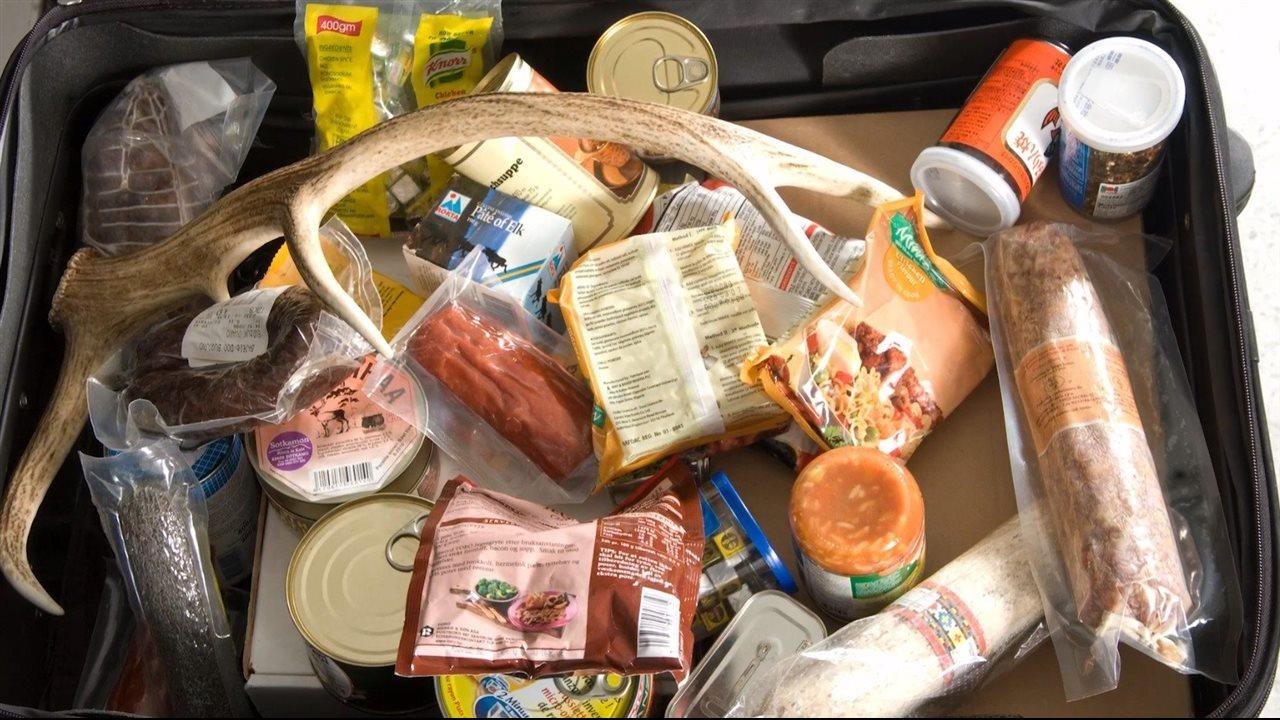

Travel spikes every holiday season, and 2025 is no different. With over half of Americans planning holiday trips this year, it's critical for all travelers to be aware of relevant restrictions and guidelines.
Many travelers don't realize that they cannot bring pork into the United States.
When African swine fever was detected in the Caribbean in 2021, the U.S. Department of Agriculture (USDA) created a protection zone to restrict people from bringing pork products with them when traveling to or between the U.S. mainland, Puerto Rico, and the U.S. Virgin Islands.
Since the protection zone's creation, over 240,000 pounds of pork have been seized from travelers leaving Puerto Rico alone. If you're traveling to the Caribbean this holiday season, don't become a statistic. Leave the leftovers behind — especially if your holiday dishes contain pork.
Planning your holiday meals
The holiday season is a special time of year, and for many families the celebrations include festive holiday dishes that contain pork. These recipes may be handed down from generation to generation and take time and effort to prepare.
Examples include pernil, a slow-roasted pork leg or shoulder, or lechón asado, a whole pig roasted on a spit over coals in a backyard oven or large roasting box like a caja china. Both dishes can be found in the Spanish Caribbean and are often cooked to mark special occasions like the holidays.
While families should enjoy their holidays and these dishes to the fullest, those traveling to and between the U.S. mainland, Puerto Rico, and the U.S. Virgin Islands must be aware of the hidden risks and the restrictions on pork.
What is African swine fever?
African swine fever (ASF) is a highly contagious, deadly virus infecting pigs worldwide. Although harmless to humans, travelers can inadvertently spread the disease by bringing pork or pork products with them from countries where ASF has been detected.
There is no vaccine or treatment for ASF, and the disease's mortality rate is nearly 100%. If one pig on one farm contracts the virus, it can infect a whole herd. If ASF spreads to the United States, millions of pigs could die, leading to pork shortages, disruption in the food supply, and higher food prices.
The United States is one of the world's largest pork producers and the second-largest exporter of pork in the world. If ASF were to infect the U.S. pork population, it could cost $74 billion over a decade.
How you can help
If you're traveling this holiday season, you can be part of the ongoing effort to keep ASF out of the United States. To help prevent the spread of ASF, the USDA's Animal and Plant Health Inspection Service recommends these steps:
- Don't bring food containing pork with you when you travel.
- If you're traveling internationally, declare all meats, animals, and animal products to U.S. Customs and Border Protection (CBP) when you arrive in the United States.
- Tell CBP if you have been on a farm, near livestock or near wild pigs.
- After you return to the U.S., wait at least 5 days before visiting any location with pigs including farms, livestock markets, zoos, circuses and pet stores with pot-bellied pigs.
Enjoy your holiday meals and festivities safely, knowing you've done your part to help keep ASF out of the United States.
Learn more about ASF and your role in preventing its spread at www.aphis.usda.gov/stopasf.


